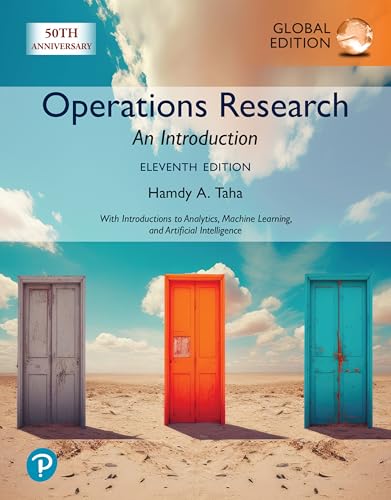
Operations Research: An Introduction -- Global Edition: aN INTRODUCTION. 11th
Hersteller:
Pearson Education
· MPN: 11976768
Günstigster Preis
82,31 €
inkl. MwSt.
Bei 1 Anbieter im Vergleich
Zuletzt aktualisiert: 12.05.2026 10:22 Uhr
Produktfakten auf einen Blick
- Hersteller
- Pearson Education
- EAN
- 9781292736099
- Hersteller-Artikelnr.
- 11976768
- Kategorie
- Controlling
- Günstigster Preis
- 82,31 € (averdo DE)
- Anbieter im Vergleich
- 1 Shops
Produktbeschreibung
For courses in operations research. Theory, applications, and computations of operations research Operations Research uses a combination of theory, applications and computations to teach operating research (OR) basics. It focuses on algorithmic and practical implementation of OR techniques. Numerical examples explain often difficult math concepts, helping students grasp the idea without getting stuck on complex theorems. Full case studies and math-free anecdotes show how algorithms are used in real life. The 11th Edition introduces analytics, artificial intelligence, and machine learning topic
Bewertungen & Erfahrungen
Für dieses Produkt liegen noch keine Bewertungen vor. Sei der oder die Erste!
Noch keine Erfahrungsberichte vorhanden.
Teile deine Erfahrung und hilf anderen bei der Kaufentscheidung.
Preisvergleich
1 Angebot gefunden
* Alle Preise inkl. MwSt., ggf. zzgl. Versandkosten. Preise und Verfügbarkeit können sich seit der letzten Aktualisierung geändert haben. Beim Klick auf „Zum Angebot" oder „Zum Shop" verlässt du testmonster.de und wirst zum jeweiligen Händler weitergeleitet. testmonster.de erhält ggf. eine Provision — für dich entstehen keine Mehrkosten. Letzte Aktualisierung: 12.05.2026 10:22 Uhr.